


COBOL to Python, C#, or Java
Converting COBOL code to a Modern Language C#, Python or Java enables your code to utilize
some of today’s best practices, including unit testing
and version control.
In an ever-changing environment, systems must be
adaptable, which means testing and version control
are essential. Using a modern language can reduce your time to release by weeks, allowing your development team to focus on developing better business applications instead of getting bogged down maintaining code.
Database Modernization
Moving past DB2 databases is critical to achieving a better future for your company. This switch will enable access to newer database engines such as MS SQL, PostgreSQL, AWS Aroura, MongoDB, AWS DynamoDB and other NOSQL Databases.
What is COBOL?
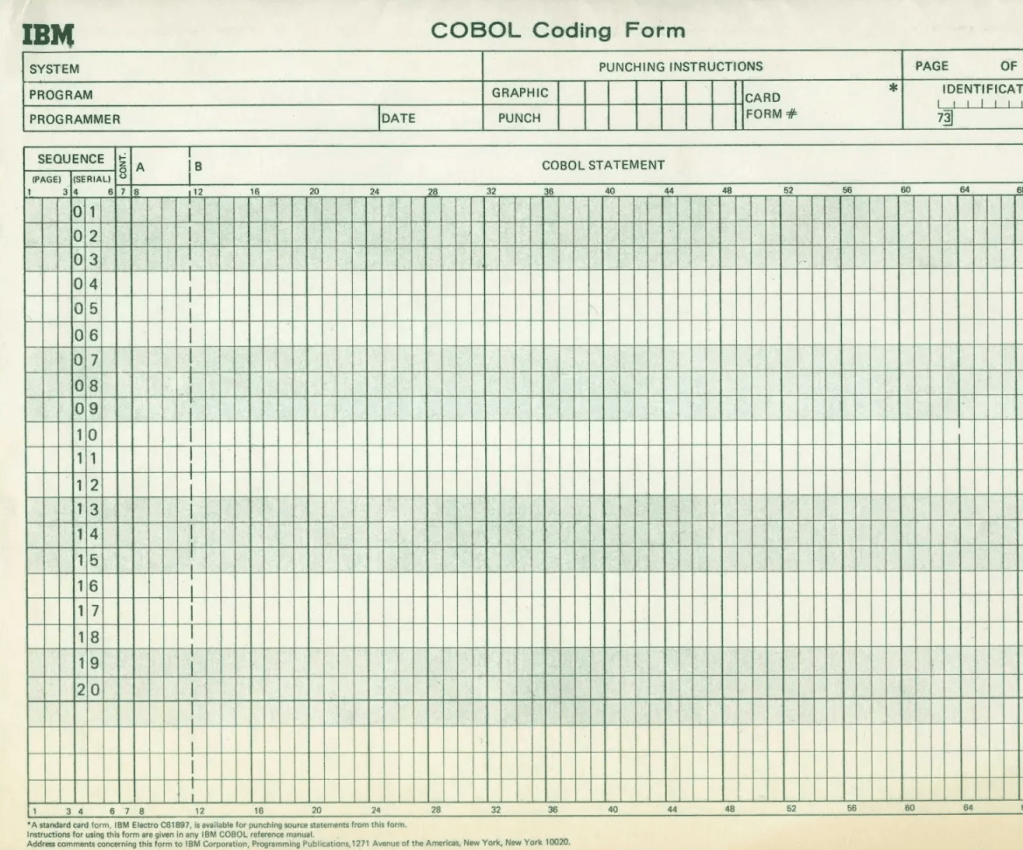
Common Business-Oriented Language (COBOL) is a reliable programming language designed by CODASYL and Grace Hopper in 1959. COBOL is used in many industries, from
finance, to defense, to healthcare. COBOL is becoming less relevant with the rise of cloud architecture, and a transition to modern languages opens the door for your business to
modernize.
Pros:
- English-like syntax.
- IBM Mainframe language.
- Proven, well-adopted, and stable.
Cons:
- Deprecated.
- Hardware/Platform specific.
- SME diminishing talent pool.
- Lack of continuous integration.
- Inability to easily gather metrics.
What is Python?
Python was developed in 1990 by Guido van Rossum. Python is a growing and versatile language with an expanding repository.
Pros:
- Class-building and object-oriented.
- Platform agnostic.
- Utilizes unit testing and a continuous integration programing model.
- Easily gathers metrics, monitor programs, and generates reports.
- Large Repository of Packages.
- Strong community and SME talent pool.
- Flexible code change.
- Superior version control.
- Improved code documentation.
- Use of async functionality.
Cons:
- Less stable than COBOL.
- Version updates may require more continuous integration.
- Syntax can become convoluted. depending on architectural design.
- Interpreted Language.
- Less performant than C#, or Java.
What is C#?
C# (pronounced “See Sharp”) is a modern, object-oriented, and type-safe programming language. C# enables developers to build many types of secure and robust applications that run in .NET & .NET CORE. C# has its roots in the C family of languages and will be immediately familiar to C, C++, Java, and JavaScript programmers.
Pros:
- Object-oriented compiled language.
- Runs on Windows and Linux.
- High-Level Language with Memory access capabilities.
- .NET & .NET CORE platforms.
- C-Family Language.
- Visual Studio IDE.
- Garbage Collection.
- Type safe with dynamic capabilities.
- Utilizes unit testing and a continuous integration programing model.
- Easily gathers metrics, monitor programs, and generates reports.
- Large Repository of Packages.
- 5th place in SME talent pool.
- Flexible code change.
- Superior version control.
- Improved code documentation.
- Use of async functionality.
Cons:
- Less performant than Java and C++.
- Dependent on .NET platform.
What is Java?
Java, introduced in 1995 by Sun Microsystems, has become a prominent object-oriented programming language in the software development domain. Its most distinguishing characteristic is the ability to run on a variety of platforms, thanks to its Write Once Run Anywhere (WORA) approach. This approach allows developers to craft java code once and execute it on any platform with a Java Virtual Machine (JVM). Java is user-friendly and portable, with automatic memory management and a robust Java runtime environment. Its ecosystem consists of three primary components: the Java Development Kit (JDK), the Java Class Library, and the Java Virtual Machine (JVM). These components make Java stand out among other native programming languages and contribute to its widespread adoption in the software industry.
Pros:
- Object-oriented compiled language.
- Platform Independence.
- C-Family Language.
- Garbage Collection.
- Distributed Language
- Heightened Security.
- Utilizes unit testing and a continuous integration programing model.
- Easily gathers metrics, monitor programs, and generates reports.
- Large Repository of Packages.
- Strong community and SME talent pool.
- Flexible code change.
- Superior version control.
- Improved code documentation.
- Use of async functionality.
Cons:
- Less performant than C++.
- Licensing Costs.
- Poor GUI
- Significant memory space required.
- Verbose and complex code.
We can help you Make the Change!

We have extensive experience in COBOL, C#, Python and Java programming languages, refactoring and modernizing code to today’s standards and best practices. Plus, there are many additional functions to explore once you convert to modern code, including AI, graphing and plotting, and sentiment analysis. Are you ready to reduce time spent maintaining code and open your business to the possibilities of adaptable code? Then make the change from COBOL to Python, C# or Java! GTS team can help your business convert your existing COBOL code into Python, C# or Java, and set you up for success as you integrate this new code.

 Genetic Thought Software Inc.